In short
- It starts with a message, and a voice note is fine. You don’t need words, photos or a budget figured out, and you leave the first call with answers and nothing to decide.
- The proposal is short: one price for the whole site, a few ways to pay it, and what the same work usually costs with three different people.
- Then come two conversations about your words, a design you shape with me, a site that does some of the work on its own, and the day it becomes yours.
Before you write
Most people who write to me took a long time to do it, sometimes two years, and I understand why.
Your work is something you feel deeply, and handing it to someone who might not get it, or who might make it sound smaller than it is, feels like a real risk. On top of that, most of what you read about websites is written in a language nobody in our world speaks, so it is easy to believe you have to arrive with everything figured out.
You don’t. This is the whole list of what you need to start, next to the list of what most people think they need.
What you need to start
- A few lines about what you do, or a voice note
- Your Instagram or your current site, if you have one
- Half an hour for a call
What you can leave for later
- The words for your site
- Good photos
- A logo
- Knowing what a domain is
- An exact budget
If you are not even sure you need a new site, there are five questions that give you a straight answer, and they don’t ask for your email.
The whole path, on one page
Before the details, this is everything that happens, in order, with what you do and what you decide at each step. In the first two, you decide nothing at all.
A message
- You
- Write, or send a voice note
- You decide
- Nothing
The first call
- You
- Ask your questions first
- You decide
- Nothing yet
The proposal
- You
- Read it, then we go through it together
- You decide
- Yes, or not now
If you pay in parts, the first one is here
Two conversations
- You
- Talk about your work and your people
- You decide
- You approve every word
Direction and design
- You
- React to what I show you
- You decide
- What you like
The build
- You
- Carry on with your life
- You decide
- Nothing, I build
It becomes yours
- You
- Get your editor and a short video
- You decide
- Whether you want maintenance
The first message, and the first call
The first message can be as messy as you like. “I run retreats and my site embarrasses me” is a perfect first message, and so is a voice note recorded in the car between two sessions. I answer it myself, and from then on I am the only person you talk to.
On the call, you go first. You ask whatever you have been wondering, about prices, about time, about AI, about what happens if you don’t like the design, and you get straight answers. Then I ask you three things: what you offer, who it is for, and whether there is a date coming, like a retreat in spring or a festival in summer.
Sometimes the honest answer on that call is that you don’t need me yet. A link page might do the job for now, or a few changes on the site you already have, or a small site done in a day or two for a symbolic price. I would rather tell you that on the first call than sell you something you will not use, and either way you leave with answers and nothing to decide.
A proposal you can read in five minutes
If it makes sense to go ahead, a written proposal comes to you after the call. It is short on purpose, a couple of pages, because you should be able to read it over a cup of tea and know exactly what you are saying yes to. It follows the same order every time, so each part prepares the next one.
Your proposalTwo pages
What I understoodYour goal and what is in the way, in your words
Ideas for your siteWhat it could do on its own, so you get time back
What I will doThe work, in a few lines
What this usually costsWith three different people
My priceOne number for all of it
Ways to payPick the one that fits your season
The next stepOnly one, and only if you want it
Then we book a second call and go through it together, line by line, until the number works for both of us. If you need a few days, or a few weeks, to think about it, that is fine too.
What it costs, and why it is one person
On most projects like yours, three people share the work. Someone works out what to say, someone writes the pages, and a designer who also builds turns it into a site. Each of them can be very good at their part, and you end up as the messenger in the middle, carrying feedback from one to the other, and finding out at the end that the real headline does not fit in the design.
With three freelancers
- Working out what to say550 to 1,400€
- you, carrying the messages
- Writing every page600 to 1,500€
- you, carrying the messages
- Designing and building the site1,000 to 3,000€
Together, usually2,150 to 5,900€
With me
One person, from the first call to the handover
- Working out what to say
- Writing every page
- Designing and building the site
- 0€ a year in hosting afterwards
A new site, usually2,000 to 6,000€
Moving a site you already have starts at 1,000€
I want to be honest about this part: my price is close to what three good freelancers would cost together. What changes is everything around the number. You explain your world once, to one person who already knows it. Nobody relays anything, so nothing gets lost on the way, and the four or five months this takes when you coordinate it yourself become a few weeks. And afterwards there is no monthly platform to pay, because keeping the site online costs 0€ a year.
The proposal has one price for the whole site, and then a few ways to pay it, so you can choose the one that fits your season.
All at once
When you say yes, and then you never think about it again.
In three parts
When you say yes, when you approve the direction, and when you see the finished site.
Over more months
Smaller parts, the same total, for a season when money comes in slowly.
One page first
The page that matters most goes live first, and the rest comes later.
Part in exchange
A course or a session I would genuinely want can cover part of it.
If the number is still too big, tell me anyway. If the timing is right and we are a good fit, we find the shape together.
Your words, before any design
Once you say yes, the first thing we do is talk, twice. The first conversation is about you and your people: who comes to you, what they are feeling before they find you, and what makes your work different from someone nearby offering something that sounds similar. The second is about the site itself, what each page has to do and how it should feel.
There are thirty-eight questions ready, though they are a guide more than a form, and whatever comes up, we follow it. I write it all back to you as the Brand Message Playbook: what you stand for, who you are talking to, the few ideas your brand repeats everywhere, and how you sound. Then I write every page from it, in your voice, the way you would say it out loud, and you approve every word before anything visual exists.
Easier than I expected. You drew things out of me that I probably couldn’t have on my own.
That was Ana, right after her two conversations, and it is the thing I hear most often at this step.
Then the design, at your rhythm
With the words agreed, the design has something real to hold. Usually in the first week you see the opening of your homepage, sometimes in two or three versions, or a moodboard with more than one direction, and you tell me what you like in each. I keep folding that back in until you like what you see.
In this world, life has its own rhythm, a retreat, a course, a season that fills up. When you need a few weeks before you can look at the next step, the project simply waits for you, and the site can go live in parts, with the most important page first.
A site that does some of the work
This is the part people rarely think to ask for. A website can quietly take over the small jobs that eat your week, the ones that live in WhatsApp and in your head at eleven at night.
When a retreat ends
It leaves the programme on its own, and the next one moves to the top
An idea for any site with dates
When your team fills in a short form
The event gets its own page, with tickets
Running at Coração de Cacau
When someone wants a session while you are with a client
They pick a time and book, and it lands in your calendar
Running at Anica Cortez Healing
When the same question arrives for the tenth time
The answer is already on the page of that retreat
Running at Beatriz da Paixão
When a guest books a massage
It appears on the therapists’ live board, and the paper sheet retires
Running at a retreat center
When you are handed a receipt
A photo of it becomes a row in your spreadsheet
Running at the same retreat center
In the proposal, the part called “ideas for your site” is where these show up, chosen for your work. Some take an afternoon and some take longer, and all of them are in the price before you say yes.
The day it becomes yours
Everything technical is done before the site goes live: your own domain and email, and a site built so that Google and the AI assistants can read it. Then you get your own editor, labelled in your words, with a short video showing what you can change. A date, a price, a photo or a whole event is a five minute job, and edits cost nothing, because you are the one making them.
The code, the domain and the content are all in your name, and keeping the site online costs 0€ a year. If you would rather not touch it at all, maintenance is 50€ a month, with every edit and update included.
Who you would be talking to
I meditate, I go to cacao ceremonies, ecstatic dances and family friendly festivals, and I was going for years before any of it was work. Most of my clients I met there, long before they were clients, so you will not have to explain what cacao is, what the dancing is for, or why the decision took you two years.
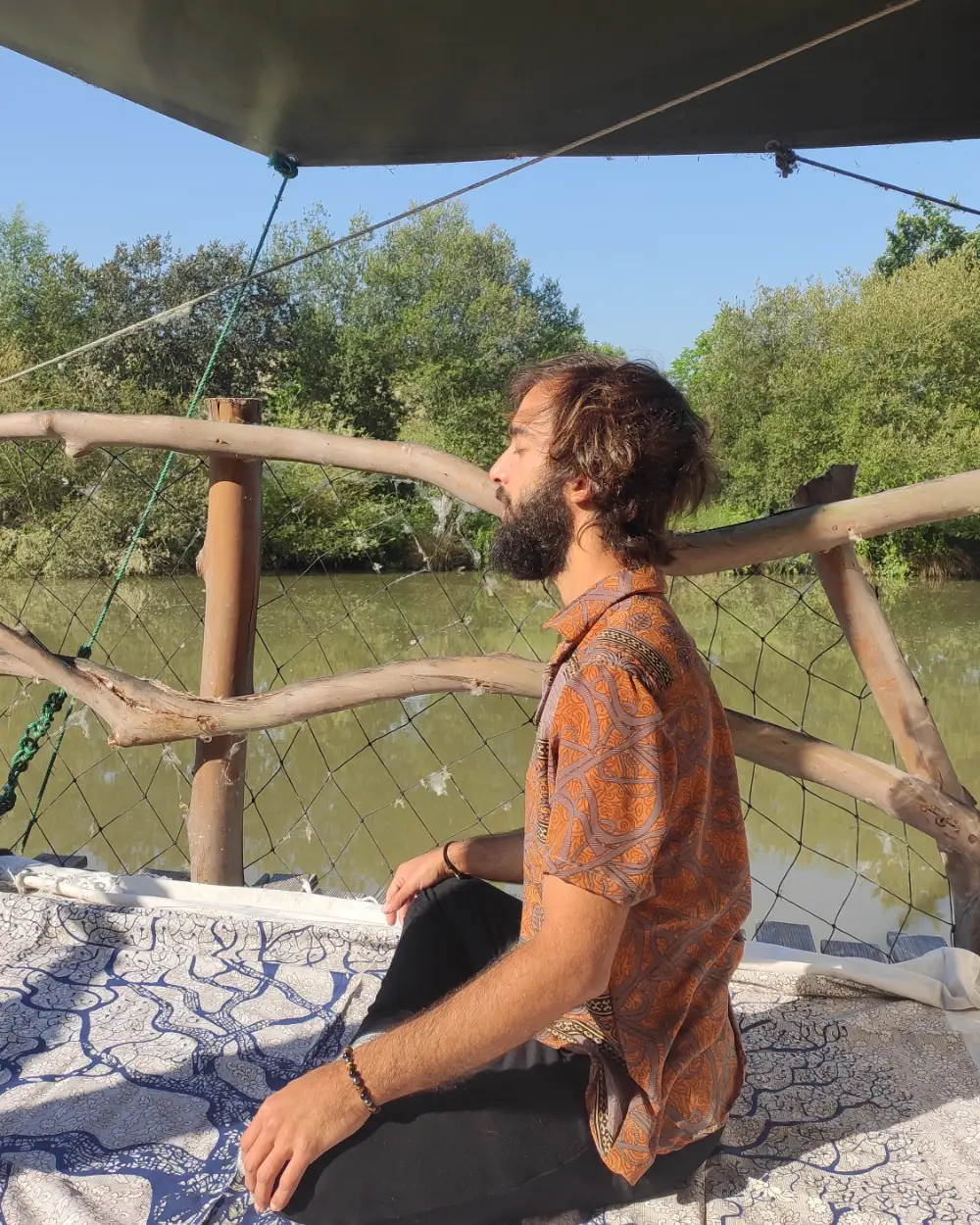
Before this, I studied computer engineering and wrote code for a living for five years, and then I learned brand, copywriting and design, so the thinking, the words and the build all come from the same person. I take three projects at a time, so each one has all of me.
If you have been thinking about it for a while, send me a voice note.
Tell me what you do and what is getting in the way. I will answer myself, and you will have nothing to decide yet.